
Hydraulic Radial Piston Pump: Working, Benefits and Uses
- What Is a Hydraulic Radial Piston Pump?
- Why Is It Important?
- Types and Variants
- Features to Look For
- Product Overview
- Benefits of Choosing a Radial Piston Pump
- Applications and Use Cases
- Comparison Table: Radial vs Axial Piston Pump
- Expert Tips / Buying Guide
- About NTH
- Conclusion
A closer look at the pump technology powering India's toughest hydraulic systems
Walk onto any heavy-duty plant floor and something becomes obvious fast — presses that never stop, test rigs cycling through the day, mining equipment chewing through rock hour after hour. Somewhere behind all that grind sits a hydraulic radial piston pump, quietly holding pressure steady. Not a flashy component. Not something anyone notices until it fails. But take it out of the equation and the whole system starts to wobble.
Why this pump specifically? Ordinary pumps start losing their edge once load gets heavy and stays heavy. This one doesn't, mostly because the mechanics behind it are simple — almost stubbornly so — and built to tight tolerances that don't leave much room for slack.
What Is a Hydraulic Radial Piston Pump?
Picture pistons arranged like spokes on a wheel, all pointing inward toward a central shaft. That's the basic layout of a Hydraulic radial piston pump. As the shaft spins, an eccentric cam shoves each piston in, then lets it back out — in on the suction stroke, out on discharge. Nothing complicated about the idea. The engineering is where things get interesting, and it's what makes this pump worth trusting inside a demanding hydraulic pumping system.
Look across the different hydraulic pump types on the market and one thing sets radial piston designs apart — pressure. These pumps handle loads well past 700 bar without much fuss, which is more than most alternatives can claim.
Why Is It Important?
Not every application calls for a high pressure hydraulic pump — plenty of systems get by fine without one. But forging presses, injection molding lines, test benches? Those need tight tolerances, near-zero leakage, output that doesn't waver. A basic pump won't hold up. That's exactly the gap an industrial hydraulic pump fills. Round-the-clock machines simply can't tolerate flow that dips or pressure that spikes without warning.
There's a cost side to this too, one people sometimes overlook. Unplanned downtime eats into production numbers quickly, and a fair share of that downtime traces straight back to a pump that couldn't keep up. Spend a bit more upfront on the right component, and it usually pays for itself long before the first major service is due.
Types and Variants
Radial piston pumps come in a few flavors, not just one standard build:
- Fixed displacement units – constant flow, good fit for steady-demand systems
- Variable displacement units – output adjusts on the fly when flow needs shift mid-cycle
- Multi-piston configurations – more pistons, smoother flow, less pulsation to deal with
- Cam-ring driven models – tend to show up in compact, high-torque setups
All of these sit under the wider category of hydraulic pump types. Which one fits depends less on theory and more on how the machine actually gets used, day in and day out.
Features to Look For
A short checklist before buying one of these pumps:
- Rated pressure range — check it against peak load, not just the average
- Noise and vibration — quieter usually means better bearing life and happier operators
- Displacement adjustability, in case the system needs variable flow down the line
- Seal and piston build quality, since these parts wear first under nonstop cycling
- Fit with existing hydraulic pressure pump circuits and manifolds already in place
Skip this step and you end up with a pump that reads great on a spec sheet but falls flat once it's actually running.
Product Overview
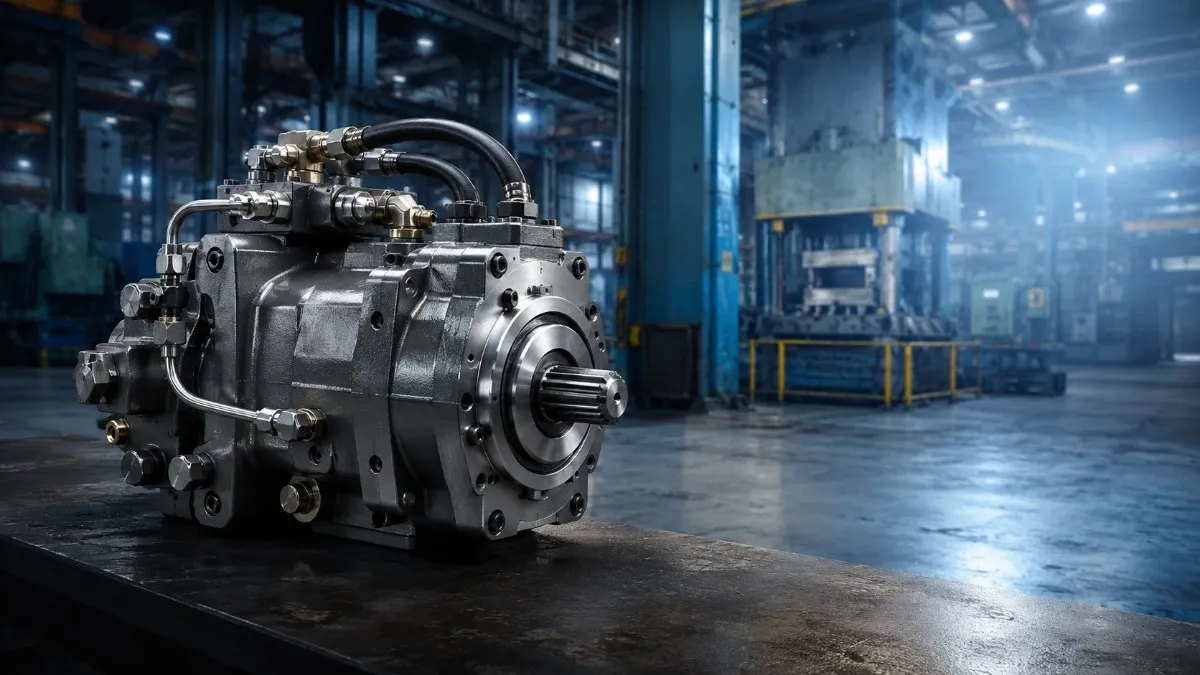
Inside a typical Hydraulic radial piston pump, pistons sit arranged around a rotating shaft, all packed into a fairly compact block. They stay in constant contact with the cam, so intake and discharge overlap continuously rather than firing in separate bursts. That overlap is exactly why flow stays smooth even when speeds drop low — other pump styles tend to struggle right there. And the housing itself doesn't need much room, which matters when panel space is tight but the job still demands serious pressure.
TRIVIA: Radial piston pump designs go back to early 20th-century hydraulic machinery — long before anyone had settled on what "high pressure" even meant.
Benefits of Choosing a Radial Piston Pump
Why engineers keep coming back to this design:
- Holds up under extreme pressure without volumetric efficiency dropping off
- Quieter running than a lot of other piston-style pumps
- Long service life, even with continuous heavy-duty use
- Small footprint given how much pressure it puts out
- Pairs well with variable displacement for flexible flow control
- Less maintenance downtime, assuming filtration is done right
DID YOU KNOW?: A radial piston hydraulic pump, kept in good condition, can outlast several standard gear pumps put together — fewer parts under direct wear stress makes the difference.
Applications and Use Cases
Radial piston pump applications turn up across a surprisingly wide range of industries:
- Metal forming and forging presses – pressure consistency here directly shapes part quality
- Plastic injection molding machines – cycles need to repeat precisely, every time
- Mining and construction equipment – excavators, cranes, tunneling rigs
- Wind turbine hydraulic systems – pitch and yaw control depend on it
- Automotive test rigs – simulating suspension loads, stress testing over and over
- Machine tools – stable clamping and actuation pressure, no exceptions
FACT: Pumps rated well past 700 bar are almost always radial piston or a specialized axial piston build — barely any other pump category holds up that far.
Comparison Table: Radial vs Axial Piston Pump
Direct comparison between radial and axial piston pumps for better understanding:
| Feature | Radial Piston Pump | Axial Piston Pump |
|---|---|---|
| Piston Arrangement | Positioned radially around a central shaft | Aligned parallel to the shaft |
| Best Suited For | Heavy-duty, high-pressure industrial use | Compact or mobile equipment |
| Efficiency at High Pressure | Very high | High, particularly with variable displacement |
| Noise Levels | Generally lower | Slightly higher |
| Flow Control | Strong for variable-flow needs | Available in fixed or variable form |
Side by side like this, it's easier to see which Radial piston hydraulic pump actually fits a given system, instead of guessing off a spec sheet.
Expert Tips / Buying Guide
Here are some commendable tips worth keeping in mind before finalising a purchase:
- Match rated pressure to the system's peak load, not some average figure
- Check seal material against whatever hydraulic fluid is actually in use
- Ask if the manufacturer backs the unit with integration support, not just a sale
- For nonstop-duty applications, favor pumps with proven cooling and filtration compatibility
- Deal with established hydraulic pump manufacturers in India who can show real testing data, not just claims
Price alone is a poor way to decide. Comparing spec sheets properly, asking the awkward questions, requesting test data where possible — all of that costs a little time upfront but saves a lot more later.
About NTH
N.T. Associates has spent over a decade building one thing — hydraulic systems that actually hold up. Hydraulic hosepipes, precision components, motors, vane pumps, power packs — everything we make is built around real application demands, not just technical specs. We don't work through catalogues or assumptions. Every customer conversation starts with understanding the operation — what it handles, where it runs, and what failure costs. That's how we design solutions that fit, not just products that ship. Manufacturing plants, heavy equipment operators, and process industries across India rely on us because our products are consistent and our support is direct. Tell us what your system needs. We'll build it.
Conclusion
A hydraulic radial piston pump rarely gets much attention, yet it's often the one part standing between a system that holds pressure and one that buckles under load. Forging press, mining rig, wind turbine pitch control — doesn't matter which. This design brings the strength and consistency high-demand industries actually rely on. Get a handle on the radial piston pump working principle, and choosing the right unit stops being a guessing game.
|
Looking for a dependable, high-pressure radial piston hydraulic pump for your next project? Reach out to us at N.T. Associates to discuss the right fit for your system. |
Noise isn't just an operator comfort issue — it's often a signal. Radial piston pumps tend to run quieter than axial designs, and lower noise usually correlates with better bearing life and less internal stress. So a noisier unit might be flagging wear issues well before anything shows up on paper.
Rated pressure against peak load, not just the average figure. Seal material compatibility with the actual hydraulic fluid in use. Noise and vibration levels, since quieter usually means better bearing life. And whether the manufacturer actually backs the unit with integration support rather than just selling and disappearing.
Depends entirely on how the machine runs day to day. Fixed displacement suits steady, constant-demand systems fine. Variable displacement makes more sense when flow needs shift mid-cycle — molding lines, test rigs, that sort of thing. Neither one is universally "better," it's really about matching the application.
Anywhere pressure consistency actually matters — forging presses, injection molding lines, mining and construction equipment, wind turbine pitch control, automotive test rigs, machine tools. Basically any setup where flow can't afford to dip or spike mid-cycle. That's the common thread running through nearly every application.
Considerably longer, assuming filtration and maintenance stay on track. Fewer parts sit under direct wear stress here, so the pump ages slower even under nonstop, heavy-duty cycling. Some units end up outlasting several gear pumps combined — not an exaggeration, just how the mechanics hold up over time.
It comes down to the piston layout — arranged like spokes around a central shaft instead of parallel to it. That design lets the pump handle pressures well past 700 bar without losing efficiency. Most other pump styles start struggling long before they get anywhere near that range.