
Hydraulic Cylinders for Construction Machinery Applications
- Why Hydraulic Cylinders Are Important in Construction Machinery
- Key Construction Equipment Applications of Hydraulic Cylinders
- Factors to Consider When Selecting Hydraulic Cylinders for Construction Equipment
- How Quality Hydraulic Cylinders Improve Construction Machine Performance
- Choosing the Right Hydraulic Cylinder Manufacturer for Construction Applications
- Conclusion
Just stand next to an excavator for a few minutes. Bucket in, arm round, boom up. What's doing all that? Cylinders. Basically, a hydraulic cylinder uses pressurised oil to push or pull in a straight line, and on a construction site that's the movement that gets the job finished. It's rough work too. Think dust, sudden shocks and ten hours a day for hydraulic cylinders for construction machinery. So here's a plain look from N.T. Associates at where they're used, how to pick one and what to ask a supplier.
Why Hydraulic Cylinders Are Important in Construction Machinery
Picture a cylinder as one strong arm with a single trick. Oil is pumped in on one side. The piston gets shoved along, and the rod comes out or slides back in. Simple? Yes. But that is the very thing that makes booms go up and down and makes blades go ahead. In simple words, a hydraulic cylinder on a construction machine changes the hydraulic power into mechanical power.
On a normal job site, that force gets used for:
- Lifting: Booms, arms and heavy loads
- Pushing: Soil, rubble and loose material
- Digging: Forcing the bucket into hard ground
- Positioning: Holding an attachment at the angle the operator wants.
The operator controls it all through valves, so a machine moving several tonnes can still be handled gently when needed. No surprise, then, that Hydraulic cylinders for construction machinery. show up on nearly every machine you'll see on site.
Did You Know? “Here's the science behind it. Pascal's law says pressure on a fluid in a closed space is passed on equally everywhere inside it. Back in 1795, Joseph Bramah took out a patent for the first hydraulic press built on that idea.”
Key Construction Equipment Applications of Hydraulic Cylinders
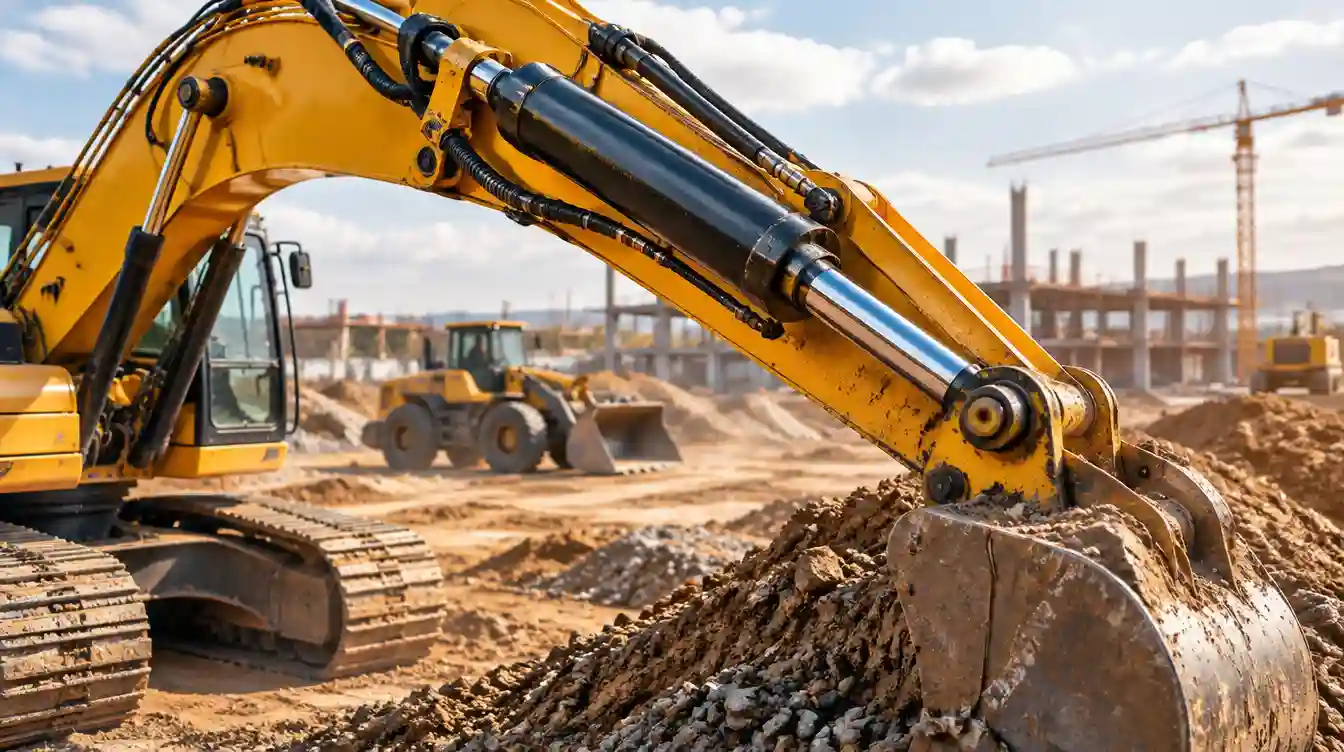
Walk around any site and you'll spot cylinders on almost every machine. A heavy duty hydraulic cylinder has to put up with shock, side loads and plenty of mud. Here's where they work hardest:
- Excavators: Boom, arm and bucket cylinders set digging depth, reach and dumping.
- Loaders: Lift and tilt cylinders raise the bucket and keep the load level
- Cranes: Telescopic and luffing cylinders extend the boom and set its angle.
- Bulldozers: Blade cylinders control the lift, tilt and push
- Backhoe loaders: Cylinders on the loader arm, the digging boom and the stabiliser legs.
Across all these Hydraulic cylinder applications, the need is the same. The cylinder has to keep working, shift after shift. N.T. Associates supplies hydraulic systems to the construction industry for cranes, excavators and other heavy equipment. And that's the point: one weak cylinder can hold up a whole crew.
Hydraulic Cylinders in Excavators and Earthmoving Equipment
An excavator leans on three sets of cylinders. Here's how the work is split:
- The boom cylinders raise and lower the boom
- The arm cylinders retract the arm and extend the arm, thus determining the reach.
- Bucket cylinders curl the bucket to cut, scoop and dump.
Every excavator hydraulic cylinder system is subject to shock. If it starts leaking or if the rod bends, the entire operation will come to a halt. The same goes for every earthmoving equipment hydraulic cylinder of any other machinery like a loader or dozer.
Hydraulic Cylinders in Cranes and Load Handling Equipment
Cranes ask cylinders to do something different: stay put. A crane hydraulic cylinder often holds a load in the air, so drifting isn't an option. In hydraulic lifting systems, watch for these:
- The load remains constant as soon as the lever is released.
- There are no jerks while extending the boom.
- Side forces on the boom are handled safely
|
For more information, you can also read our blog: A Complete Guide to Hydraulic Cylinders: Types, Uses & Benefits |
Factors to Consider When Selecting Hydraulic Cylinders for Construction Equipment
A wrong choice in the cylinder is going to cause problems immediately. Seals give way, rods bend, or the machine just feels tired. That's why hydraulic cylinder selection should start with how your machine works day to day, and not with a brochure. Before you order, check:
- Load capacity: It should cover the maximum working load, with some margin to spare.
- Operating pressure: Match the rating to your system, including sudden pressure spikes.
- Stroke length: Enough to move the boom or arm fully, without over-travel
- Mounting configuration: Clevis, flange or trunnion, whichever suits your machine's structure.
- Sealing quality: Good seals keep oil in and dust out
- Environmental conditions: Mud, heat, rain, salty air. Each one changes which seals and rod coating will survive.
Here's the catch with an Industrial hydraulic cylinder: if it only fits on paper, you'll pay for it in repairs. Test the choice against real site conditions first, and you won't.
Trivia: “Many cylinder rods carry a hard chrome plating. The smooth and durable surface is difficult to scratch and doesn’t rust quickly, making the rod seal last for a long time.”
How Quality Hydraulic Cylinders Improve Construction Machine Performance
A good cylinder doesn't just move a part. You feel it in how the whole machine behaves. Here's what quality gives you on site:
- Productivity is improved: More can be achieved per shift due to smoother and faster cycles.
- The downtime is reduced because there is less maintenance required for leakage and failure.
- Better reliability: Steady force on every stroke, even with a heavy load
- More longevity: Better machining and seals minimize wear
- Increased efficiency: Less oil bypassing the piston means less energy wasted.
After a few months, there will be many hydraulic cylinder benefits to appreciate: less maintenance, less downtime, and more productivity.
That's what a reliable hydraulic cylinder pays you back with, and it can outweigh the price tag.
Choosing the Right Hydraulic Cylinder Manufacturer for Construction Applications
Selecting a hydraulic cylinder manufacturer does not only involve perusing their catalogue. It is also necessary to evaluate the quality of construction of the hydraulic cylinder, customizability and the services offered by the supplier. Here are some of the considerations when selecting Hydraulic cylinder manufacturers in India:
- Machining Quality: Check the quality of machining at the cylinder bore, piston rod, and piston. A good machining process will ensure that the cylinder moves smoothly while working.
- Testing: Check whether the company tests the cylinders before delivery to determine any issues regarding pressure and leaks.
- Technical Support: A good supplier should give technical support in product selection and any questions arising after purchasing the product.
Hydraulic Cylinders, pumps, motors and valves are offered by us at N.T. Associates in standard as well as customized specifications.
Conclusion
Cylinders do a lot of quiet work on a site. They are always ignored until one breaks down. That’s why you have to consider basic specifications before purchasing such as load, pressure, stroke, and mounting. Get those right and breakdowns become rare. Then talk to a hydraulic cylinder supplier who asks about your machine first. A quote that arrives with no questions? Be careful with that one.
| Need a hydraulic cylinder manufacturer in India? Talk to N.T. Associates. Tell them your bore size, pressure and mounting needs. |
Open one up and you’ll see a rod and a piston. Pressurised oil pushes the rod out, and the rod moves the machine part attached to it. Every bucket scoop and boom lift on a busy site starts with it.
Excavators use them. Cranes and bulldozers need them too, along with wheel loaders and backhoe loaders. If a part has to rise or tilt, a cylinder is usually doing it. Every machine gets one size for the work it does.
First read the manual. The load, pressure, stroke length, and mounting requirements will all be found there. Verify that they match the requirements for the cylinder prior to purchase. The site condition is important as well. Sand and mud get everywhere, and they hurt the seals.
A low price can mislead. Seals fail first when the rod surface is rough, and then oil starts leaking. Good steel and clean machining avoid that, which saves you repair bills and idle days on site. Quality pays back quickly.
Oil dripping near the rod is the first red flag. Slow, jerky or uneven movement is another sign. So are strange noises and a rod with bends or scratches. Don’t keep running the machine. Have a technician look at it.
Shortlist two or three manufacturers first. Can they supply your bore size, stroke and pressure? Do they test every cylinder? Will someone help after the sale? N.T. Associates supplies hydraulic products and customised options for equipment, so it’s worth asking.