
What Is a Directional Control Valve? Types and Working Explained
- Common Challenges Users Face
- Product Overview
- How the Product Solves the Problem
- Key Features and Benefits
- Common Directional Control Valve Types
- Solenoid Operated Directional Control Valve
- Real-World Applications
- Actuation Methods at a Glance
- Why Choose This Brand
- NTH
- Conclusion
How directional control valves manage flow, direction, and overall machine performance in industrial hydraulics.
Ever watched a hydraulic cylinder jerk instead of gliding? That's a valve issue. Not the pump. Not the operator. A directional control valve decides where fluid goes, and when. Get that wrong, and the whole machine feels off - sluggish, jumpy, unpredictable.
Most people ignore this part until something breaks. Fluid starts leaking. Response lags. Downtime stacks up fast, and none of it's cheap. So here's what a directional control valve actually does, the types worth knowing, and where each one belongs. No fluff, no jargon dump - just what actually matters on the floor. Read it once, and picking the right valve gets a lot less confusing.
Common Challenges Users Face
- Actuators moving inconsistently - nine times out of ten, it's a mismatched valve.
- Leaks. Quiet ones. They drain pressure over weeks without anyone noticing.
- Lag between signal and movement. Small delay, big headache on automated lines.
- Overheating - usually flow's blocked, or running the wrong way.
- Hunting for a genuine Hydraulic Directional Control Solenoid Valve Manufacturer in India isn't as easy as it should be.
- Valves that quit after a few thousand cycles, sometimes fewer.
- Not knowing which directional control valve types even fit your machine.
Product Overview
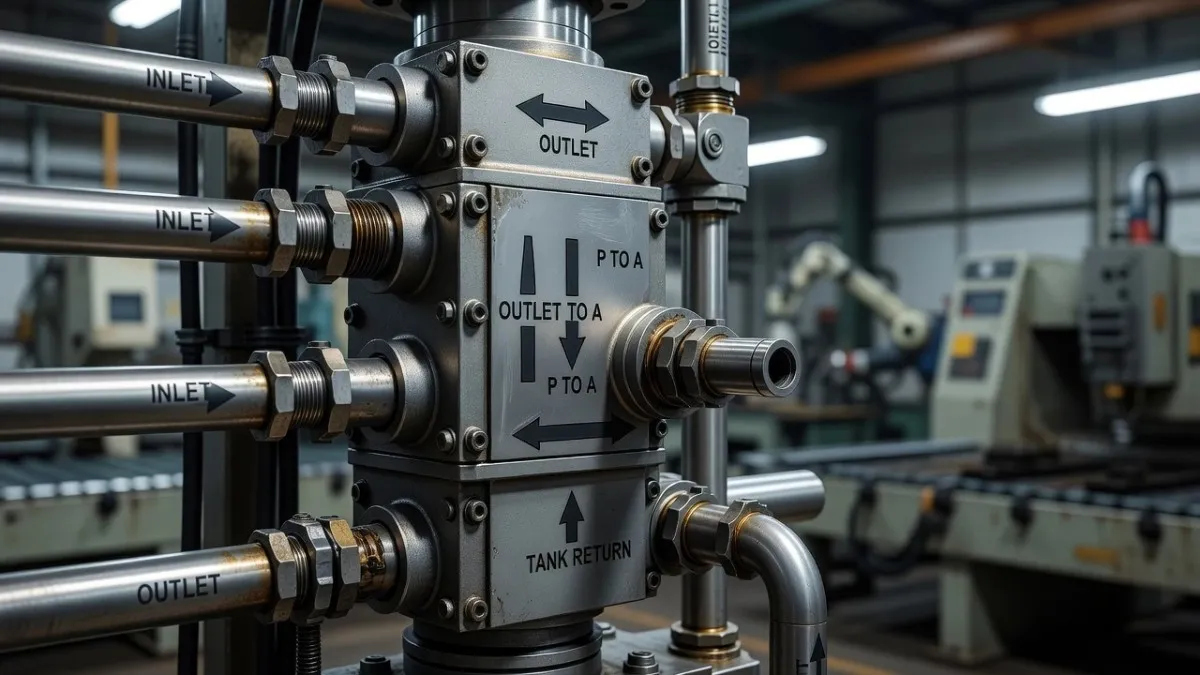
So, what's a Hydraulic Directional Control Valve? Simple answer: it's the part deciding where fluid flows, and when it stops. Sits quietly between pump and actuator, doing the real work behind every extend, retract, hold.
There's a spool inside. It slides back and forth. That's it - that's the trick. Sliding opens some paths, shuts others. Sounds basic, and honestly it is, but that's exactly why one hydraulic valve can run several functions off a single pump. No spool movement means no directional control. Nothing complicated about that part, even though engineers spend a lot of time perfecting the tolerances.
Did You Know? Manual levers ran directional valves for decades before solenoids showed up. Old tech, but it worked fine.
How the Product Solves the Problem
Here's the working of directional control valves, stripped down: spool shifts, ports open, fluid goes where it's told. Signal arrives - mechanical, hydraulic, pneumatic, electrical, doesn't matter - spool reacts. That's the whole story.
Break it into steps, and the hydraulic control valve working principle looks roughly like this.
- Pump pushes fluid into the valve body.
- Spool receives a signal and shifts.
- Certain ports open, others shut, all at once.
- Fluid heads toward whichever port just opened.
- Actuator responds - extends, retracts, or just holds.
- Extra fluid drains back to the tank.
That's the directional valve function, in short. Not exciting stuff, but it's exactly what keeps a machine from lurching in the wrong direction.
Key Features and Benefits
- Tight control over actuator direction and speed - no guesswork involved.
- Small footprint, fits where bigger valves simply won't.
- Handles multiple porting setups depending on the circuit.
- Works across manual, hydraulic, pneumatic, or electric actuation.
- Burns less energy than older-generation valves.
- Holds up under nonstop industrial cycles, not just light use.
- Slots into existing manifolds and power packs, no redesign needed.
- Predictable behavior - fewer nasty surprises on the shop floor.
Common Directional Control Valve Types
Not every job calls for the same valve. Directional control valve types differ by port count and position count, and honestly, picking the wrong one gets expensive fast.
- 2/2 valve - two ports, two positions. Just on-off, nothing more.
- 3/2 valve - three ports, two positions. Shows up a lot on single-acting cylinders.
- 4/2 valve - four ports, two positions. Reverses direction for double-acting cylinders.
- 4/3 directional control valve - four ports, three positions. Extend, retract, or park in neutral.
Of all the types of hydraulic valves out there, the 4/3 usually wins in industrial setups. Reason? That neutral center lets the actuator sit still without the pump grinding away for nothing.
Trivia: Why "4/3"? Four ports, three spool positions - the name basically hands you the spec sheet before you crack open a catalog.
Solenoid Operated Directional Control Valve
A Solenoid operated directional control valve skips the lever altogether. Electric coil does the job instead - current flows, magnetic field builds, spool snaps into place. Fast. Repeatable. Made for automation, not manual grunt work.
- Switches quicker than any manual valve could.
- Pairs easily with PLCs and automated control setups.
- Cuts down manual work - fewer people needed on the floor for it.
- Keeps performing across long, repetitive cycles without drama.
Real-World Applications
So where do these actually turn up? Pretty much everywhere hydraulics do real work.
- Excavators and loaders - construction runs on this stuff, plain and simple.
- Tractors and harvesters, agriculture's backbone.
- Industrial presses, material handling lines.
- Automotive assembly floors and testing rigs.
- Marine deck cranes, steering setups.
- Turbines and tracking systems in energy plants.
Fact: A single directional control valve can juggle several actuator functions at once - fewer parts, less clutter, simpler circuit.
Actuation Methods at a Glance
| Actuation Method | How It's Triggered | Response Speed | Best Suited For |
|---|---|---|---|
| Manual | Lever or pedal, hand operated | Slow | Simple, low-cycle applications |
| Mechanical | Cam or plunger driven by machine motion | Moderate | Machine-tool automation |
| Hydraulic (pilot) | Pressurized fluid signal | Fast | High-force shifting needs |
| Pneumatic | Compressed air signal | Fast | Clean environments, moderate force |
| Solenoid (electric) | Electromagnetic coil energised by current | Very fast | Automated, PLC-controlled systems |
Why Choose This Brand
Sourcing a hydraulic valve isn't something to rush through. A real Hydraulic Directional Control Solenoid Valve Manufacturer in India tests for pressure resistance, checks seals properly, and won't ship a valve until spool movement is consistent - every time, no exceptions.
Need a Hydraulic Directional Control Solenoid Valve in India that won't quit mid-project? N.T. Associates sticks to precision machining, in-house testing, and compatibility with hydraulic brands people already trust. Anyone chasing a Hydraulic Directional Control Solenoid Valves Supplier usually cares more about consistent build quality than flashy sales talk.
Same story for OEMs and resellers. A dependable Hydraulic Directional Control Solenoid Valve Wholesalers in Ghaziabad partnership keeps supply steady exactly when it's needed most. That's the real difference between an actual industrial partner and just another seller passing through, chasing whatever order comes next.
NTH
N.T. Associates has spent over a decade building one thing — hydraulic systems that actually hold up. Hydraulic hosepipes, precision components, motors, vane pumps, power packs — everything we make is built around real application demands, not just technical specs. We don't work through catalogues or assumptions. Every customer conversation starts with understanding the operation — what it handles, where it runs, and what failure costs. That's how we design solutions that fit, not just products that ship. Manufacturing plants, heavy equipment operators, and process industries across India rely on us because our products are consistent and our support is direct. Tell us what your system needs. We'll build it.
Conclusion
A directional control valve isn't much to look at - small, tucked away, easy to forget about. Yet it does more heavy lifting than almost anything else in the circuit. Move from a basic 2/2 setup to a 4/3 directional control valve, match it to the actual job, and machine reliability stops feeling like a gamble.
Construction, agriculture, automation - doesn't matter which. The right hydraulic valve means fewer breakdowns, lower costs, and a lot less stress for whoever's handling maintenance. Get the type right from the start, and it just becomes a part nobody has to worry about again. That's really the whole point of picking well the first time.
| Need a dependable hydraulic directional control valve for the next build? Talk to our hydraulic team - we'll point you toward what actually fits. |
It decides where fluid goes inside a hydraulic circuit, and when. Think of it as a traffic signal for pressurized fluid — open one path, block another, and the actuator moves accordingly. Without it, a cylinder would have no reliable way to extend, retract, or hold its position on command.
Both have four ports, but positions differ. A 4/2 valve only switches between two positions, reversing flow direction. A 4/3 directional control valve adds a third, neutral position, letting the actuator hold steady without pump load. That extra position makes a real difference in precision-heavy applications.
Current flows through an electromagnetic coil, which builds a magnetic field strong enough to pull the internal spool into a new position. No manual lever, no pedal — just electricity doing the shifting. That's what makes it fast, repeatable, and easy to wire into automated or PLC-driven systems.
2/2, 3/2, 4/2, and 4/3 valves cover most industrial needs. Simpler setups often use 2/2 or 3/2 for basic on-off control, while 4/2 and 4/3 handle double-acting cylinders. Choosing between them really comes down to how many positions and functions the specific circuit actually needs to run smoothly.
The spool is the moving part inside the valve body. Shift it, and different ports open or close instantly. That single movement decides whether fluid extends a cylinder, retracts it, or simply holds it in place — which is why spool alignment sits at the center of everything the valve does.
Yes, and that's actually the point. A single hydraulic directional control valve can manage several actuator functions just by shifting spool position differently each time. This cuts down on the number of components needed in a circuit, which means less clutter, easier maintenance, and fewer parts that can fail.