
The Invisible Insulator: Scaling and Fouling in Hydraulic Heat Exchangers
- Use of the Hydraulic Heat Exchanger
- What Is Mineral Scaling?
- What Is Fouling in Hydraulic Heat Exchangers?
- Why the Mineral Depositions Are Called the Invisible Insulation Material
- Factors That Lead to Scaling and Fouling
- Impact of Scaling on Hydraulic Systems
- Indications That You May Have a Fouled Hydraulic Heat Exchanger
- Mineral Scaling & Fouling Prevention
- Hydraulic Heat Exchanger Cleaning Techniques
- Heat Exchangers for Hydraulic Power Packs
- The Importance of Knowing the Hydraulic Symbol of the Heat Exchanger
- Selecting the Appropriate Hydraulic Heat Exchanger
- Why opt for N. T. Associates?
- About NTH
- Conclusion
Hydraulic systems are the core components of industries, enabling functions ranging from injection molding machines and CNC machinery to steel mills, construction machines, marine machines, mining machinery, and power packs. Though the pumps, valves, and cylinders get more focus when the systems are being maintained, one very important component is usually ignored—that is the Hydraulic Heat Exchanger. The role of this vital component is to keep the hydraulic oil at an optimal operating temperature.
One of the major hidden risks faced by hydraulic heat exchangers is the formation of mineral deposits, which causes fouling and scaling. Mineral deposits are often known as the 'invisible insulator' because they build up in the cooling tubes and impair the efficiency of heat transfer without being readily visible as any indication of failure. This results in the increased temperature of operation of hydraulic systems, which increases costs, affects reliability, and leads to premature wear of components.
N.T Associates is a recognized Hydraulic Heat Exchanger Manufacturer of India that manufactures highly efficient heat exchangers which are suitable for all kinds of industries. We are also recognised as the most trusted Hydraulic Heat Exchanger Supplier of India, Hydraulic Heat Exchanger Wholesaler of India, and Hydraulic Heat Exchanger Dealer of India.
Use of the Hydraulic Heat Exchanger
The hydraulic equipment generates substantial heat during operation. This arises due to mechanical friction, pressure, leakage and continued circulation causing heating of the hydraulic oil. The heat generated reduces the viscosity of the oil, causes oxidation, leads to seals wear and shortens the life span of the pump and valves.
The heat is removed through the Hydraulic Heat Exchanger whereby the heat is transferred from the heated hydraulic oil to the coolant such as water or air. In the water cooling system, cold water will be pumped within the pipes and hydraulic oil in the outer side of the pipes.
- Proper operating temperature will ensure:
- Viscosity of hydraulic oil
- Operation efficiency of the machinery
- Life span of the hydraulic components
- Low cost of maintenance
- Machine efficiency
- Energy Conservation
What Is Mineral Scaling?
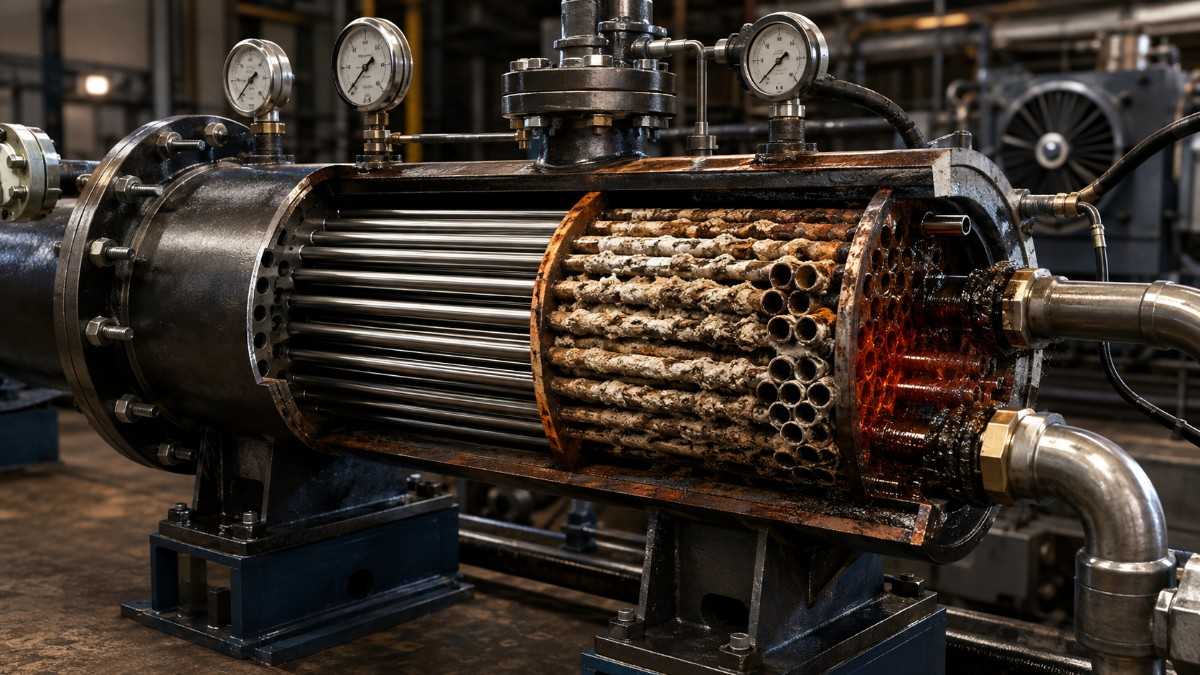
It is a process in which mineral components contained in the cooling water including calcium carbonate, magnesium salts, silica, among others, precipitate inside the walls of the pipe used in the heat exchangers.
The deposition of minerals continues resulting in hard deposits that cannot be easily removed because of the constant flow of water through the heat exchangers.
As opposed to equipment failure, mineral scaling occurs gradually.
What Is Fouling in Hydraulic Heat Exchangers?
Fouling is the deposition of undesirable materials in the heat exchange area.
Apart from the formation of scales, fouling may be caused by the following factors:
- Rust particles
- Corrosive materials
- Organic material
- Algae
- Particles of dirt and sand
- Oil fouling
The deposition of both scale and fouling results in the formation of an invisible coating which isolates the coolant from the hydraulic oil.
This coating makes the heat transfer ineffective, resulting in overheating of the hydraulic equipment.
Why the Mineral Depositions Are Called the Invisible Insulation Material
There is always an assumption that since water is flowing through the heat exchanger for cooling purposes, then it is functioning efficiently.
However, the truth of the matter is that even little mineral deposits become insulating materials.
Unlike other materials, which can be copper or stainless steel, the mineral deposits are very bad conductors of heat.
As the mineral deposits become thicker:
- Transfer of heat becomes inefficient.
- Oil temperatures rise.
- The water is unable to absorb more heat.
- The equipment is subjected to thermal stress.
- Energy consumption rises.
Factors That Lead to Scaling and Fouling
There are different reasons for scaling that occur within water-cooled hydraulic heat exchangers.
Hard Water
Water with a high concentration of calcium and magnesium is the leading factor in scaling.
High Water Temperature
Warm water facilitates rapid mineral scaling.
Poor Water Quality
The presence of suspended solids, sand, and dissolved particles speeds up fouling.
Low Water Flow Rate
Water flowing slowly facilitates mineral scaling.
Insufficient Water Treatment
Filtration and water chemicals can reduce scaling but when absent scaling occurs at a much higher rate.
Maintenance
Neglected maintenance allows scaling to become hard and makes its elimination more difficult.
Did you know? Hard water containing high levels of calcium and magnesium is the primary cause of mineral scaling in water-cooled hydraulic heat exchangers.
Impact of Scaling on Hydraulic Systems
Scaling affects not only the ability to cool but much more.
Heating Up of Hydraulic Oil
With the lack of proper heat dissipation, the cooling is not possible.
Reduced Lifetime of the Oil
Heating up causes oxidation and decomposition of oil components.
Wear and Tear of Pumps
Overheating of hydraulic oil leads to reduction of its viscosity.
Deterioration of Seals and Hoses
Due to higher temperatures, hoses and seals start deteriorating.
Decreased Efficiency of Equipment
Overheating of equipment leads to machine downtime or slower speed.
More Power is Needed
In order to function properly, additional power is needed.
Costs of Maintenance Increase
Additional repairs and oil replacement will be needed.
Indications That You May Have a Fouled Hydraulic Heat Exchanger
There are early warning signs that operators should watch out for, which include:
- Increasing temperature of the hydraulic oil
- Decreasing effectiveness of the cooling process
- High energy use
- Noise from the pump
- Overheating alarms
- Poor machine performance
- High water pressure in the cooling system
- Deposit presence on inspection
Mineral Scaling & Fouling Prevention
Maintenance is the best approach to ensure proper operation of heat exchangers.
Water Treatments
Soft water or chemical treatment of water can reduce scaling greatly.
Install Filters
Filters will help prevent suspended solids from entering the cooling process.
Check the Water Quality
Testing of hardness and pH levels will prevent excessive scaling.
Schedule Maintenance Cleaning
Regular cleaning is required to prevent scaling from becoming too hard to clean.
Maintain Proper Flow
Flow velocity should be maintained to prevent scaling inside the tube.
Inspect Heat Exchangers
Inspections will help detect scaling before it affects the cooling process.
Hydraulic Heat Exchanger Cleaning Techniques
There are different cleaning methods that can restore the efficiency of heat exchange.
Chemical Cleaning
Specific chemicals for descaling remove mineral deposits from the exchanger without causing any damage.
Mechanical Cleaning
Specific brushes, rods, or mechanical tools remove hard deposits.
High-Pressure Water Cleaning
Water pressure helps remove loose deposits and sediments.
Preventive Flushing
Regular flushing prevents the formation of deposits.
It is important to know which cleaning method should be used depending on the type of exchanger and deposits.
Did you know? Treating cooling water with softening systems or scale-control chemicals can significantly reduce mineral buildup and improve the efficiency of hydraulic heat exchangers.
Heat Exchangers for Hydraulic Power Packs
A Heat exchanger for hydraulic power packs is very important when it comes to providing a stable temperature of the oil inside the hydraulic power pack that is used in manufacturing industries, presses, machining tools, lifters, and industrial automation.
The hydraulic power pack usually works under heavy load for long periods of time; therefore, proper cooling of the hydraulic power pack is crucial.
The Importance of Knowing the Hydraulic Symbol of the Heat Exchanger
The time will come that the hydraulic symbol of the heat exchanger will become an issue for engineers since the hydraulic symbol of the heat exchanger is a part of hydraulic circuit schematics which represents a heat exchanger in a hydraulic circuit.
It is essential information for technicians who work with industrial hydraulic systems.
Selecting the Appropriate Hydraulic Heat Exchanger
Some of the operating conditions which will determine the selection of an appropriate heat exchanger include:
- Heat capacity
- Oil flow
- Quality of cooling water
- Pressure
- Temperature range
- Available installation area
- Compatibility of materials
- Accessibility of maintenance.
Dealing with professional manufacturers is important in selecting an appropriate heat exchanger.
Did you know? Factors such as oil flow rate, cooling water quality, operating pressure, and temperature range all play a critical role in determining the most suitable heat exchanger for your application.
Why opt for N. T. Associates?
With our Hydraulic Heat Exchangers being amongst the best Hydraulic Heat Exchanger Manufacturers in India, we have built ourselves a reputation of providing our clients with cooling solutions that can cater to the needs of today’s industries. The heat exchangers provided by us are made out of superior quality materials and are made with advanced technology and engineering practices.
Being one of the renowned Hydraulic Heat Exchanger Suppliers in India, Hydraulic Heat Exchanger Wholesalers in India, and Hydraulic Heat Exchanger Dealers in India, we have been serving customers belonging to manufacturing, steel, power, marine, construction, mining, automotive, and process industries.
About NTH
N.T. Associates has spent over a decade building one thing — hydraulic systems that actually hold up. Hydraulic hosepipes, precision components, motors, vane pumps, power packs — everything we make is built around real application demands, not just technical specs. We don't work through catalogues or assumptions. Every customer conversation starts with understanding the operation — what it handles, where it runs, and what failure costs. That's how we design solutions that fit, not just products that ship. Manufacturing plants, heavy equipment operators, and process industries across India rely on us because our products are consistent and our support is direct. Tell us what your system needs. We'll build it as per your specific needs and requirements.
Conclusion
Although scaling and fouling are invisible, they affect the overall functioning of the hydraulic systems. Just a small layer of deposits within a Hydraulic Heat Exchanger results in inefficient cooling, high temperatures, shorter equipment lifespan and more frequent maintenance.
| Identifying the factors responsible for scaling, practicing preventive maintenance and choosing the right heat exchanger will assure thermal management efficiency. For quality products, do contact N.T. Associates Now! |
Hydraulic Heat Exchanger is a mechanism used to cool the hydraulic fluid by removing excess heat and thus maintaining an optimal working temperature. It helps prevent overheating, protects the pumps, valves, and seals and improves the performance of the hydraulic systems.
The reason for mineral scaling in the water-cooled heat exchangers is the deposition of dissolved minerals (calcium, magnesium, and silica) in the hard water inside the tubes of the heat exchangers. This leads to a decrease in the efficiency of the process and overheating of the hydraulic fluid.
Scaling and fouling are the insulating layers that reduce the efficiency of the heat transfer and may cause overheating, higher energy usage, wear of the hydraulic parts, inefficiency of the machinery, and even its failure.
A hydraulic power pack heat exchanger is used to keep the hydraulic fluid that is used in power packs cool, guaranteeing constant operating temperature even when used for long durations of time. Its use improves equipment efficiency, increases the lifetime of components, and avoids any potential overheating.
The heat exchanger hydraulic symbol is a symbol used in the hydraulic circuit schematic to show the heat exchanger component in the system.
N.T. Associates is one of the best Hydraulic Heat Exchanger Manufacturers in India. With our experience as supplier, wholesaler and dealer in India, we are able to deliver products and services that are reliable and customised to suit the needs of industries.