
A Complete Guide to Hydraulic Cylinders: Types, Uses & Benefits
-
What Is a Hydraulic Cylinder?
- Why Is It Important?
- Types of Hydraulic Cylinders
- Features to Look For
- Product Overview
- Hydraulic Cylinder Applications and Use Cases
- Comparison Overview
- Expert Tips and Buying Guide
- NTH
- Conclusion
A practical look at hydraulic cylinder types, how they work, and which one actually fits your machinery.
Every construction site's got one cylinder for sure. Every factory floor too — usually more than one, tucked away in machines nobody looks twice at. A hydraulic cylinder doesn't get much attention until it stops working, and then suddenly it's the only thing anyone cares about. Fluid pressure goes in, mechanical force comes out. That's the whole trick, really, and a huge chunk of heavy industry runs on exactly that principle. Cranes, presses, tractors, dump trucks — strip away the paint and the branding, and there's a cylinder doing the actual work underneath almost every time.
This piece covers the basics without dragging things out. What a hydraulic cylinder actually does, the types worth knowing, where they show up on the job, and a few pointers before you buy one. Nothing fancy here — just what a procurement team or a site engineer actually needs to know before placing an order.
What Is a Hydraulic Cylinder?
A Hydraulic cylinder is an actuator. Pump pressurized fluid into a barrel, a piston inside gets pushed, and that push travels down a rod to whatever's attached — a bucket, a press plate, a lifting arm, doesn't really matter what. Force in, motion out. That's it.
- Turns fluid pressure into straight-line mechanical force
- Small housing, big output — that's the whole appeal
- Handles repetitive loads without breaking a sweat
- Rated anywhere from moderate pressure right up to extreme
- Built for duty cycles that would wreck lesser components fast
Why Is It Important?
Machines need force, and force needs a source. Hydraulics happen to be one of the most efficient ways to generate that force without wiring up a small power station on-site. An industrial hydraulic cylinder crammed into a housing the size of a lunchbox can out-push a room full of workers, easily. Nothing else really competes on that front, not in the same footprint anyway.
|
TRIVIA: Joseph Bramah built the first practical hydraulic press back in 1795. Same basic principle, just far better metallurgy now. |
Downtime's the real cost, though. One bad cylinder and a whole line stops cold. Nobody budgets for that kind of stoppage, and it's exactly why sourcing from someone who actually pressure-tests before shipping matters more than most people think it does. A cheap cylinder that fails in month three isn't cheap at all once you tally up the lost hours.
Types of Hydraulic Cylinders
Cylinders aren't interchangeable, whatever a catalog might suggest. Get the wrong one on a job and maintenance costs pile up fast, sometimes within weeks. Here's a rundown of the Types of hydraulic cylinders that actually show up across Indian shop floors and job sites.
Single Acting Hydraulic Cylinder
- Pressure pushes one way, nothing else
- Comes back down on gravity, a spring, or the load's own weight
- Fewer parts, fewer seals, less to go wrong overall
- Shows up in jacks, dump beds, basic lift gear mostly
Double Acting Hydraulic Cylinder
- Pressure works both directions, push and pull alike
- Tighter control on the way out and the way back
- Built for cycles that genuinely don't let up
- Excavators, presses, automated lines — this is their cylinder of choice
Telescopic Cylinders
- Sleeves nest inside one another, extend out in stages
- Long reach out of a surprisingly short retracted package
- Tipper trucks and dump trailers lean on these heavily
Tie-Rod, Welded, and Mill-Type Cylinders
- Construction and housing style is really the main difference
- Pick based on pressure needs, mounting, and how easy repairs will be
|
DID YOU KNOW?: A double acting hydraulic cylinder pushes and pulls with almost the same force either direction — a single acting one simply can't match that. |
Features to Look For
A short checklist before signing off on any purchase saves a lot of grief later on.
- Bore and stroke sized to the actual load, not a rough guess
- Seals matched to the fluid type and the temperature swing
- Rod hardness and corrosion resistance — skip this and regret it later
- Mounting that fits — clevis, flange, trunnion, whatever the frame needs
- Pressure rating with room to spare, never cutting it close
Product Overview
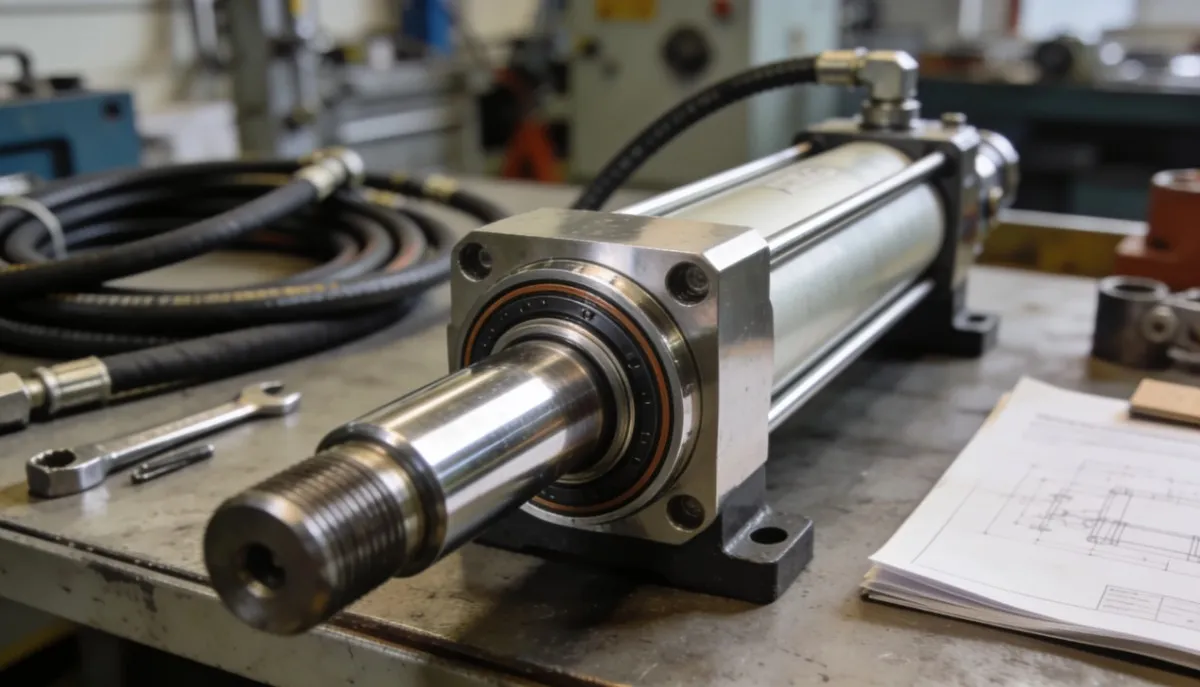
Strip one open and you'll find a barrel, piston, rod, end caps, seals, mounting hardware. Nothing exotic about any of it. What separates a good unit from a bad one is precision — how tight the bore's honed, how well the rod's finished, whether the seals were picked for the actual fluid running through the system. Hydraulic cylinder manufacturers in India worth their salt run pressure tests and leak checks on every single unit before it ships out. Skip that step and you're basically gambling.
Cut corners on plating or seal compounds and it shows up fast — a leak within weeks, a scored rod, a piston that seizes right when you least expect it. Usually it's the small stuff nobody checked.
Benefits
Here are some benefits:
- Punches well above its size in raw force output
- Smooth, controllable output that doesn't jerk or stall
- Lasts for years if it's looked after properly
- Fits almost any machine, almost any industry
- Cuts manual labor and cuts injury risk too
Hydraulic Cylinder Applications and Use Cases
Hydraulic cylinder applications turn up almost everywhere heavy work happens. Excavators and cranes on construction sites. Tractors and harvesters out in the fields. Presses and lifts running on a factory line somewhere. The list of hydraulic cylinder uses keeps growing too, honestly — marine deck cranes, aerospace test rigs, stage platforms at concerts, maintenance gear in the energy sector. Wherever something heavy needs to move reliably, a cylinder's usually working quietly behind it.
|
FACT: A hydraulic cylinder built and maintained properly can run through millions of cycles before it ever needs a rebuild. Millions. |
Comparison Overview
Here the comparison overview table:
| Type | Direction of Force | Best Suited For | Maintenance Level |
|---|---|---|---|
| Single Acting Hydraulic Cylinder | One direction, return via external force | Jacks, dump beds, simple lifting tasks | Low |
| Double Acting Hydraulic Cylinder | Both directions, extend and retract | Excavators, presses, automation lines | Moderate |
| Telescopic Cylinder | Sequential multi-stage extension | Tipper trucks, dump trailers | Moderate to High |
Expert Tips and Buying Guide
Here are the expert tips and buying guide for smoother actions:
- Match the type to the actual job at hand, not the lowest price tag
- Push suppliers on seal specs — wrong seal means fast failure, guaranteed
- Get testing certificates in writing before installation begins
- Stick with hydraulic cylinder manufacturers in India that know heavy industry, not just catalog listings
- Check the mounting fits your frame before it turns up on-site
NTH
N.T. Associates has spent over a decade building one thing — hydraulic systems that actually hold up. Hydraulic hosepipes, precision components, motors, vane pumps, power packs — everything we make is built around real application demands, not just technical specs. We don't work through catalogues or assumptions. Every customer conversation starts with understanding the operation — what it handles, where it runs, and what failure costs. That's how we design solutions that fit, not just products that ship. Manufacturing plants, heavy equipment operators, and process industries across India rely on us because our products are consistent and our support is direct. Tell us what your system needs. We'll build it.
Conclusion
A hydraulic cylinder looks like nothing special from the outside — a metal tube, basically, with a rod sticking out. Inside, there's real engineering keeping machines running shift after shift without complaint. Single acting, double acting, telescopic — the type you pick changes uptime, safety, and what you'll end up spending down the line. Worth getting right the first time around.
A bit of homework upfront — right type, solid build, proper testing — beats dealing with a breakdown mid-shift, pretty much every time.
| Need hydraulic cylinders built for actual industrial use, not just spec sheets? Get in touch with NTH and we'll help you pick the right one for your setup. |
A hydraulic cylinder is a mechanical actuator that converts pressurised fluid into linear force. It uses a piston moving inside a barrel to push or pull a rod, powering equipment like excavators, presses, cranes, and tractors across construction, agriculture, and manufacturing.
Pressurised hydraulic fluid enters the cylinder barrel and pushes against the piston. This pressure difference forces the piston rod to extend or retract, generating controlled mechanical force. Depending on the design, fluid drives one or both directions of motion.
Go telescopic when you need long reach out of a short retracted length — tipper trucks and dump trailers are the classic case. The nested sleeves extend in stages, giving far more stroke than a standard cylinder could manage from the same compact housing.
With proper maintenance and correctly matched seals, a hydraulic cylinder can run through millions of cycles before needing a rebuild. Lifespan really comes down to build precision, seal compatibility with the fluid, and whether the bore and rod were sized right for the load from day one.
Match the bore and stroke to the actual load, confirm seals suit the fluid and temperature range, and check the mounting style fits your frame — clevis, flange, or trunnion. Always get pressure-test certificates in writing; skipping that step is basically gambling on a future breakdown.
Look for manufacturers that pressure-test and leak-check every unit before shipping, not just ones with a wide catalog. Established suppliers familiar with heavy industry — not just listings — tend to catch the small stuff, like seal mismatches or rod finishing issues, before it becomes a site problem.