
Hydraulic Oil Cooler Heat Exchanger: Working Principle, Applications, and Benefits
- What is a Hydraulic Oil Cooler Heat Exchanger?
- Why is it Important?
- Types / Variants of Hydraulic Coolers
- Features to Look For
- Product Overview
- Benefits
- Applications / Use Cases
- Comparison Table: Air-Cooled vs Water-Cooled
- Expert Tips / Buying Guide
- About NTH
- Conclusion
- Get in Touch
How the right Hydraulic Cooling System keeps industrial machinery running cool, clean, and efficient
Heat happens. It's just physics — oil moves under pressure, friction builds, things get hot fast. Ignore it long enough and that heat starts eating away at seals, degrading oil, wearing down parts you paid good money for. That's the job of a Hydraulic Oil Cooler Heat Exchanger: pull the heat out before it causes real damage.
Not a luxury add-on. Not something you bolt on “just in case.” It's core to how a hydraulic circuit stays alive — press machine, injection molding line, earthmoving rig, doesn't matter which. Temperature control isn't optional, full stop. Here's what a Hydraulic Oil Heat Exchanger actually does once it's sitting in the circuit.
What is a Hydraulic Oil Cooler Heat Exchanger?
A Hydraulic Oil Cooler pulls heat out of the fluid before it loops back into the system — that's really the whole point of it. Nothing complicated going on underneath. Think of a car radiator, except this one's built around oil instead of coolant. Fluid runs through the core, and heat leaves it, either through air or through water depending on which design you're looking at.
Simple goal, really. Keep the oil in its sweet spot temperature-wise so viscosity holds steady. Skip a working Hydraulic Cooler and watch what happens — temperatures spike, and pumps, motors, valves wear out faster than they should.
|
DID YOU KNOW: quite a few hydraulic cooler cores use the same finned layout you'd find under the hood of a car — automotive radiator design, repurposed for oil. |
Why is it Important?
Heat doesn't announce itself. No warning light, no loud noise — just quiet damage building up in the background. Thin oil can't lubricate the way it needs to. Metal grinds against metal. Seals go brittle, crack. Efficiency slips. By the time something actually breaks, you're troubleshooting blind.
A properly sized Oil Cooler Heat Exchanger stops that chain reaction. Skip it, and here's roughly what you're signing up for:
- Oil that breaks down faster than it should — more frequent, more costly replacement
- Downtime, usually at the worst possible moment
- Pumps, seals, valves all wearing out early
- Wasted energy — thin, hot oil makes pumps work overtime just to keep up
|
TRIVIA: hydraulic oil oxidation roughly doubles for every 10°C rise above its ideal operating range. |
Types / Variants of Hydraulic Coolers
Two broad paths here. Most industries pick one based on what's actually practical on site:
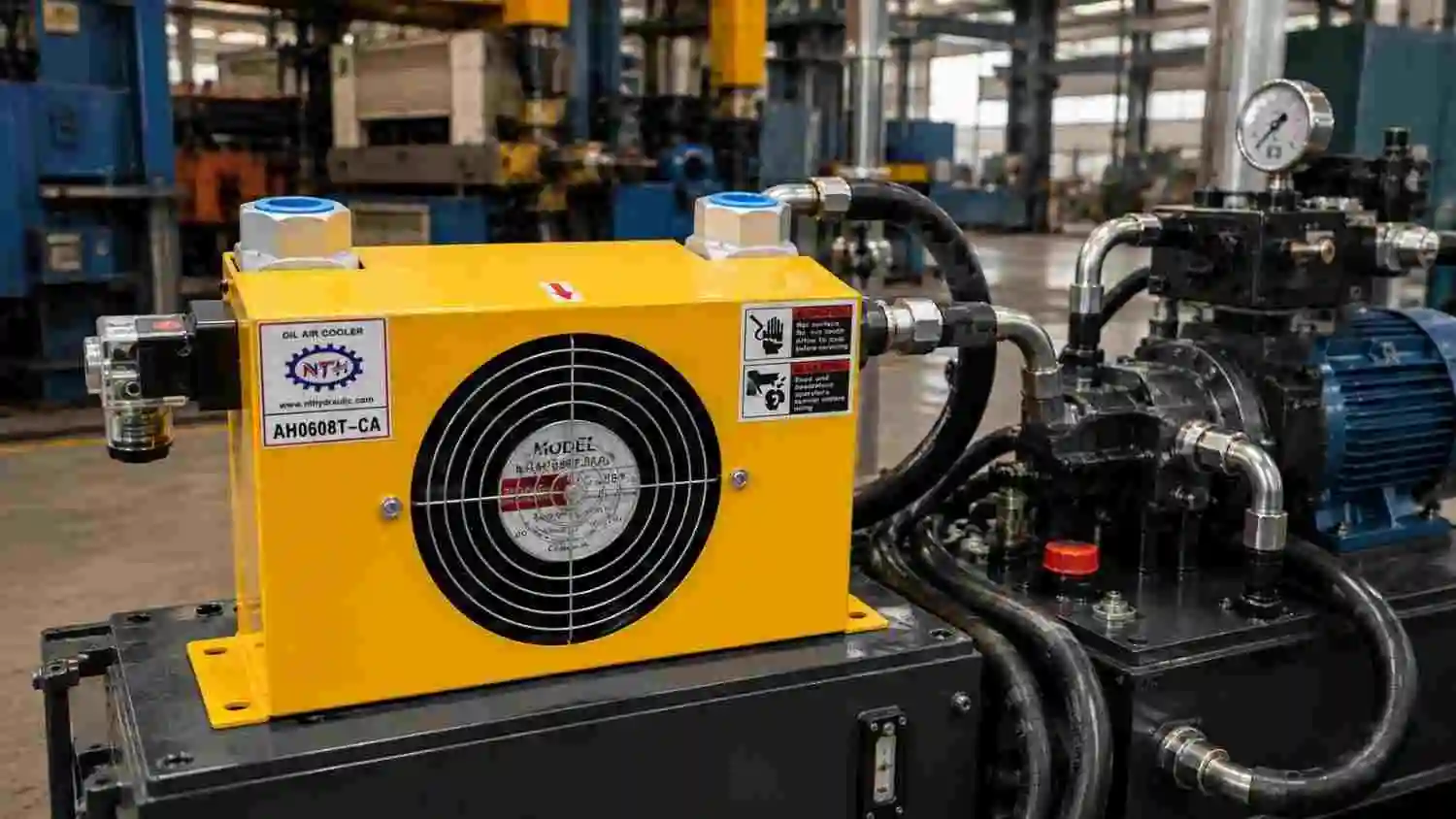
- Air-Cooled Oil Coolers — basically a car radiator's industrial cousin. A fan drives air across finned cores, heat leaves the oil. No water hookup needed, which is why these turn up on mobile gear and remote sites so often.
- Water-Cooled Oil Coolers — oil runs through tubes, water circulates around them, shell-and-tube being the common setup. Transfers heat faster. Handles heavy, continuous loads better. Makes sense wherever a plant already has water on tap.
Both sit under the wider label of a Hydraulic Fluid Cooler. Which one wins usually comes down to available utilities and how hard the machine runs, day in and day out.
Features to Look For
Horsepower and flow rate look good on a spec sheet. That's not the whole story, though. Worth checking before you buy:
- Heat dissipation matched to your actual load, not a rough guess
- Aluminum or steel core — corrosion resistance matters more than most people think
- Port sizing that fits your existing setup, no adapter gymnastics
- How much power does the fan or pump itself eat up?
- Footprint — tight mobile installs won't forgive a bulky unit
- Can you actually clean the core, or is maintenance a headache?
Tick these boxes and a Hydraulic Heat Exchanger tends to run quieter, last longer, cost less over time. Pretty much that simple.
Product Overview
We supply both air-cooled and water-cooled models — built for industrial floors, mobile rigs, marine hydraulic systems, all of it. As an Industrial Hydraulic Oil Cooler provider, our range runs from compact, mobile-friendly units right up to higher-capacity fixed setups for machinery that never really stops.
Aluminum, steel, tested under real operating pressure — not just theoretical lab numbers. Running a press? An injection molding line? Heavy mobile equipment? There's a unit built to match the flow rate and heat load you're actually dealing with.
Benefits
What does a well-matched cooling setup actually get you?
- Oil lasts longer — stable temperatures slow the breakdown process
- Pumps, seals, and hoses age slower under less thermal stress
- Machines behave predictably instead of drifting out of spec halfway through a shift
- Cooler oil flows easier, so pumps aren't fighting thick, hot fluid all day
- Fewer surprise breakdowns, fewer scrambled maintenance calls
- Safety, too — overheated hydraulic fluid is a genuine fire and pressure hazard
Running multiple shifts a day? A solid Hydraulic Cooling System is often the line between predictable upkeep and constant firefighting. Literally, in some cases.
Applications / Use Cases
Where do these coolers actually show up? Pretty much anywhere hydraulics are doing the heavy lifting:
- Hydraulic presses, stamping lines
- Injection molding setups
- Construction and earthmoving gear
- Marine hydraulic systems
- Industrial pumps, power generation equipment
- Material handling, lifting machinery
- CNC and machine tool hydraulics
If a machine pushes oil under pressure to move, lift, or press — heat management isn't optional. It's baked in.
Comparison Table: Air-Cooled vs Water-Cooled
Here's how the two setups stack up against each other, point by point:
| What to Check | Air-Cooled Oil Cooler | Water-Cooled Oil Cooler |
|---|---|---|
| What Cools the Oil | Ambient air | Circulating water |
| Utility Needed | None (self-contained) | Water supply required |
| Best Fit | Mobile and remote equipment | Continuous-duty industrial plants |
| Upkeep | Fan and fin cleaning | Tube descaling, water checks |
| Footprint | Slightly larger, usually | Tends to be more compact |
| Typical Setting | Outdoor, dusty, variable climates | Indoor, controlled facilities |
Expert Tips / Buying Guide
Before signing off on a supplier, a few things worth double-checking:
- Size for actual heat load, not just pump horsepower — oversized wastes money, undersized invites failure
- Match port sizes to your current hoses and fittings before ordering anything
- Ask what certifications apply, especially for marine or corrosive conditions
- Has the unit actually been pressure-tested, or just spec'd on paper?
- Find a Hydraulic Oil Cooler Manufacturer that sticks around after the sale, not one that disappears once the invoice clears
An experienced Hydraulic Oil Cooler Suppliers network usually asks the right questions first — flow rate, duty cycle, ambient conditions — instead of just pushing whatever's sitting in stock.
About NTH
N.T. Associates has spent over a decade building one thing — hydraulic systems that actually hold up. Hydraulic hosepipes, precision components, motors, vane pumps, power packs — everything we make is built around real application demands, not just technical specs. We don't work through catalogues or assumptions. Every customer conversation starts with understanding the operation — what it handles, where it runs, and what failure costs. That's how we design solutions that fit, not just products that ship. Manufacturing plants, heavy equipment operators, and process industries across India rely on us because our products are consistent and our support is direct. Tell us what your system needs. We'll build it.
Conclusion
Cooling isn't some afterthought bolted onto a hydraulic system. It's what keeps the rest of the system honest. Get the sizing and build quality right on a Hydraulic Oil Cooler Heat Exchanger, and you're protecting oil, components, and uptime, all in one move. Air-cooled for a mobile rig, water-cooled for a busy shop floor — either way, get it right early. Saves headaches down the line.
Get in Touch
| Need a cooling solution that actually holds up? Reach out to us to find the right hydraulic oil cooler heat exchanger for your hydraulic system. |
Pulls heat out of the oil before it flows back into the system — that's really the job in one line. Ignore that job and oil temperatures creep up fast, seals give out early, and pump parts don't last nearly as long as they should. Nothing complicated about it, just necessary.
Check the temperature gauge first, if there's one fitted — anything sitting above the normal range for a while is worth flagging. No gauge on hand? Watch for the usual tells instead: sluggish cylinders, foamy-looking oil, maybe a burnt smell drifting off the reservoir. Shutdowns tied to overheating are usually the giveaway.
Air-cooled units rely on a fan pushing air over finned cores to shed heat — no water line required, so mobile or remote jobs usually lean this way. Water-cooled types circulate water around the oil tubing instead, moving heat faster for nonstop heavy-duty loads. Really just depends on your site setup.
It depends on where the unit's sitting. Dusty, gritty sites need the fins and fan cleaned more often — monthly isn't unreasonable. Water-cooled units, check those quarterly for scale building up inside the tubes. But don't just go by a calendar. Oil temperature creeping up on its own? Go inspect it right then.
It can, actually — surprises people every time. Hot, thin oil makes pumps push harder just to hold pressure, and that eats extra energy over the long run. Get the oil properly cooled and pumps settle back into their normal range instead of fighting degraded fluid all shift. Small fix, real savings.
Just about anywhere oil's under pressure doing real work. Construction gear, injection molding floors, hydraulic presses, marine hydraulics, material handling equipment — that's the short list, not the full one. If a machine leans on hydraulics to lift, move, or press something, it needs proper cooling to keep going.