
Why Hydraulic Systems Overheat and How to Prevent It
- What a Basic Hydraulic System Is Actually Doing
- Where the Heat Actually Comes From
- Quick Reference — Causes and Fixes
- What Proper Thermal Control Actually Gets You
- How to Actually Fix It
- Where This Problem Shows Up Most
- Why N.T. Associates
- NTH
- Conclusion
For engineers and plant managers who'd rather prevent a breakdown than explain one.
Overheating doesn't announce itself. One shift the oil's a bit warm. Next week a seal starts weeping. A month later the pump's shot and production's stopped for two days. By that point nobody's asking what caused it — they're just trying to get back online.
That slow build is exactly why thermal problems in industrial hydraulic systems get missed so often. The warning signs don't look dramatic. But left alone they'll do more damage than most mechanical failures combined. Getting ahead of overheating — understanding what causes it and how to stop it — is honestly one of the best maintenance investments a plant can make.
What a Basic Hydraulic System Is Actually Doing
At its core, a Basic hydraulic system does one thing: it takes mechanical energy, converts it to pressurised fluid, moves that fluid through valves and lines, and uses it to drive something — a cylinder, a motor, a press. That's the whole job.
The heat problem comes from the losses inside that process. Anytime fluid is forced through a restriction, diverted around a valve, or recirculated because the actuator doesn't need it yet — energy that didn't do useful work has to go somewhere. It goes into the oil as heat. That's not a flaw in the design; it's just physics. The question is whether the system can shed that heat fast enough to stay in a safe operating range.
Where the Heat Actually Comes From
Most overheating problems trace back to one or more of these:
- Oil viscosity is off. Wrong grade for the operating temperature. Too thin and the pump loses its film strength. Too thick and it labours. Both generate more heat than the circuit's designed to handle.
- The reservoir's too small. Tank volume is your primary heat sink. If it's undersized — and plenty of older machines are — the oil doesn't have enough dwell time to cool before it's circulating again.
- Internal pump bypass. A pump losing internal clearances doesn't just deliver less flow — it recirculates fluid under pressure, turning lost efficiency straight into heat. Elevated case drain flow is usually the giveaway.
- Blocked filters. Clogged suction strainers cause cavitation. Blocked return filters drive up back-pressure. Either way, the pump works harder than it should and the oil gets hotter.
- Relief valve set wrong. A relief cracking open repeatedly to dump excess pressure is doing it by converting hydraulic energy into heat. The higher it's set above what the system actually needs, the more it dumps — every cycle.
Quick Reference — Causes and Fixes
Here is the easy summary for causes and fixes:
| What's Causing It | What Happens | What to Do |
|---|---|---|
| Wrong oil grade | Pump wear, film failure | Match viscosity to pump spec |
| Small reservoir | Oil doesn't cool before recirculating | Target 3–5× pump flow rate as volume |
| Worn/bypassing pump | Wasted energy becomes heat | Measure case drain; rebuild early |
| Blocked filter element | Cavitation, high back-pressure | Scheduled changes before blockage |
| Cooler too small | Temps exceed 60–70°C threshold | Size cooler for worst-case ambient |
| Relief valve too high | Dumps pressure as heat repeatedly | Set to actual system requirement |
What Proper Thermal Control Actually Gets You
Sort out the overheating problem and Hydraulic System Efficiency improves in ways that show up quickly:
- Seals stop failing early. Heat-degraded oil attacks rubber. Keep temps stable and seal replacements stop being a monthly expense.
- Oil lasts longer. Hot oil oxidises and breaks down fast. Controlled temperatures push change intervals out considerably.
- Pumps and valves run longer. Clean, cool oil maintains clearances. Components hit their rated service life instead of falling short.
- Actuator response stays consistent. Viscosity swings make cylinders and motors behave unpredictably. Stable temps mean stable performance.
- Power consumption drops. A pump fighting restrictions or bypassing internally uses more electricity. Fix the root cause and that shows up in the energy bill.
How to Actually Fix It
Here are the major tips to how actually fix it:
Get the Cooler Right
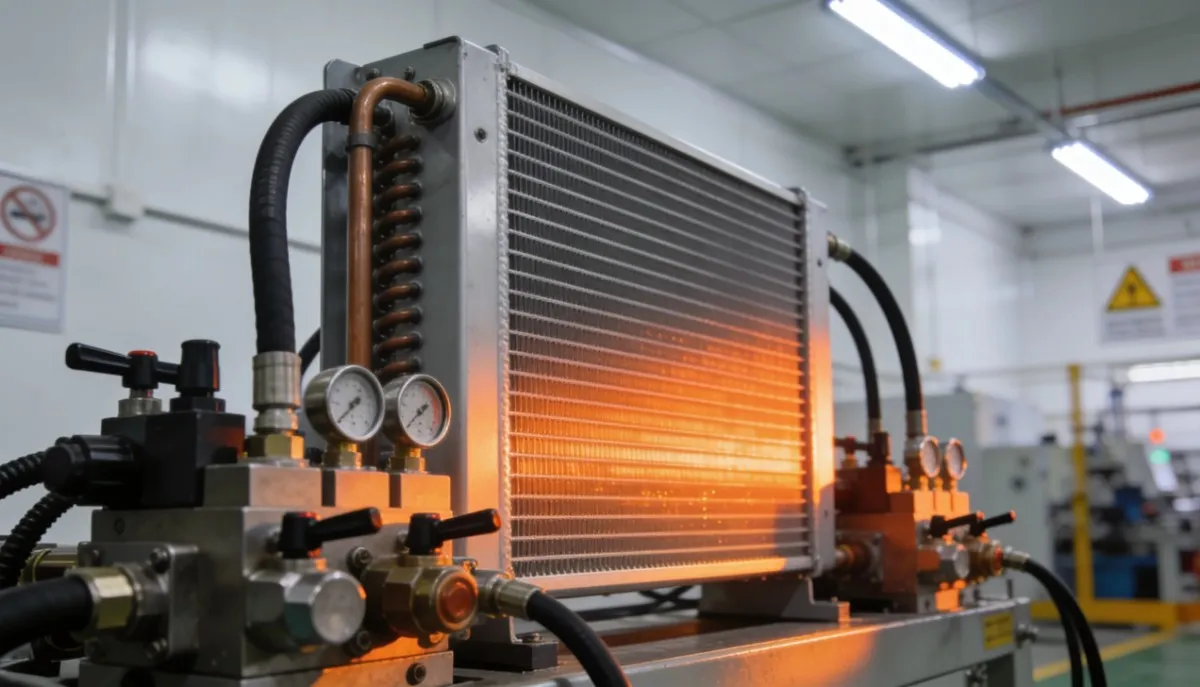
For any Hydraulic machine running more than a few hours at a time, a properly rated oil cooler is non-negotiable. Air-blast units work well where water isn't available. Water-cooled exchangers handle higher heat loads in confined spaces. The mistake most people make is sizing for average conditions — size it for the worst day of the year at peak load.
Use the Right Oil Grade
Don't just order what was always used. Pull the pump datasheet. Check the viscosity range it needs at operating temperature. A high VI oil maintains its film better as temps rise — that protects seals and internal pump surfaces. The extra cost is nothing compared to a pump rebuild.
Change Filters Before They Block
Waiting for the differential pressure alarm before changing a filter means the bypass valve's already opened — and unfiltered oil's been through your precision components. Get on a schedule. Solenoid valves, manifold blocks, and servo valves don't tolerate dirty oil and they're expensive to replace.
Keep an Eye on Pump Health
You don't need a full teardown to check pump condition. Measure case drain flow and compare it to the original figure. If it's crept up, internal bypass is increasing and so is heat output. Quality Hydraulic equipment with regular monitoring lets you schedule replacements — not react to failures.
Where This Problem Shows Up Most
Let's understand where the problems show up most and frequently:
- Press shops and fabrication lines: Long duty cycles with little idle time. Cooling has to keep up with continuous full-load operation.
- Construction equipment: Excavators and cranes running full shifts in direct sun. Ambient heat alone can push marginal systems over the edge.
- Agriculture: Harvesters work flat-out during short harvest windows. No time to wait for a cool-down.
- Oil and gas: Rigs run non-stop under extreme pressure. Thermal failures mean stopped production — every hour costs.
- Marine machinery: Deck equipment sits in poorly ventilated spaces. Heat builds with nowhere to go.
Why N.T. Associates
If you're spec'ing components or rebuilding a circuit, the supplier has to understand the application — not just ship parts. N.T. Associates is a Hydraulic systems manufacturer in India with a full product range: oil cooler heat exchangers, variable vane pumps, radial piston pumps, power packs, cylinders, manifold blocks, directional control valves, and hose pipes. Everything you need to address overheating at the source.
- As a Hydraulic Systems Supplier in India, units are customised to pressure and flow requirements — tested for leaks and pressure resistance before they leave the facility.
- As a Hydraulic Systems Dealer in India, there's real technical support behind each order — not just a catalogue and a delivery note.
- As a Hydraulic Systems Wholesaler in India, OEMs and service centres get consistent quality on bulk orders with ready stock and no import delays.
NTH
N.T. Associates has spent over a decade building one thing — hydraulic systems that actually hold up. Hydraulic hosepipes, precision components, motors, vane pumps, power packs — everything we make is built around real application demands, not just technical specs.
We don't work through catalogues or assumptions. Every customer conversation starts with understanding the operation — what it handles, where it runs, and what failure costs. That's how we design solutions that fit, not just products that ship.
Manufacturing plants, heavy equipment operators, and process industries across India rely on us because our products are consistent and our support is direct.
Tell us what your system needs. We'll build it.
Conclusion
Thermal failure in a hydraulic circuit isn't bad luck. It's the result of things that were manageable — wrong oil, undersized cooling, a pump that needed attention, filters left too long. The fix isn't complicated. What it takes is catching the problem before it compounds.
In Indian industrial conditions — high ambient temperatures, long shifts, heavy loads — getting the thermal side right from the start pays off every single day. Use properly rated hydraulic equipment, stay on top of maintenance, and work with a supplier who knows what the hydraulic system actually needs. That's the difference between a machine that runs and one that keeps breaking.
| Have an overheating issue or building a new circuit? Talk to N.T. Associates — get the right components for your application, not just the nearest available ones. |
Blocked filters and undersized reservoirs top the list. When oil can't cool down between cycles or flow is restricted, heat builds faster than the system can shed it.
Watch for sluggish cylinder response, weeping seals, or a burning smell near the tank. An oil temperature gauge reading above 60–70°C is a clear warning sign.
Most mineral hydraulic oils perform best between 45°C and 60°C. Sustained operation above 70°C accelerates seal degradation, oxidises the fluid, and shortens every component's service life considerably.
Absolutely. A correctly sized heat exchanger keeps fluid temperature stable even during long, heavy-load shifts. Without one, heat accumulates every cycle until something fails — usually a seal or pump.
Follow the manufacturer's interval — don't wait for the pressure alarm. A blocked element forces flow through the bypass, sending unfiltered hot oil straight through your precision valves and manifold blocks.
Yes, easily. Oil too thin loses its protective film under pressure; too thick makes the pump labour unnecessarily. Either mismatch generates excess heat that your cooling circuit wasn't designed to handle.