
How to Reduce Hydraulic System Downtime in Production Plants
- Traditional Solution vs Modern Solution
- Product Overview
- Key Advantages of Proactive Maintenance
- Common Causes of Hydraulic Downtime
- Industries Where Downtime Hits Hardest
- Why the Right Supplier Changes Everything
- About NTH
- Conclusion
Real fixes, not textbook theory — for plants where every stopped hour costs real money.
Machines break. That's not the problem. The problem is when nobody saw it coming — and the entire line shuts down because one seal gave out or the oil went bad three months ago and nobody checked. That's the reality in most plants running industrial hydraulic systems. Downtime doesn't arrive with a warning. It builds up slowly and hits hard when you're least ready for it.
The cost isn't just the repair. It's the halted production, the emergency labour call, the delayed order. A single unplanned failure of a hydraulic machine can wipe out an entire shift's output. The good news — most of it is preventable. Not with expensive technology. With discipline, the right components, and a maintenance approach that actually works.
Traditional Solution vs Modern Solution
Old-school maintenance in most factories meant one thing: react. Something leaks — call the technician. Something stops — order the part. That cycle is expensive and completely avoidable. Modern plants treat Hydraulic system efficiency the same way a doctor treats health — catch problems early, track vitals, replace before failure. The difference shows up directly in production reports.
| Maintenance Area | Traditional / Reactive | Modern / Proactive |
|---|---|---|
| Fault Detection | Post-breakdown inspection | Real-time sensor monitoring |
| Oil Monitoring | Scheduled intervals only | Continuous contamination tracking |
| Seal & Hose Checks | When failure occurs | Periodic pressure & visual checks |
| Filter Replacement | Fixed calendar cycle | Differential pressure-based scheduling |
| Downtime Type | Long and unplanned | Short and scheduled |
| Component Life | Shortened by neglect | Extended through preventive care |
| System Efficiency | Drifts down over time | Held close to design specifications |
The shift isn't about buying expensive equipment. It's about building habits — monitoring pressure, checking oil cleanliness, inspecting hoses before they burst. A well-maintained hydraulic system runs for years without drama. A neglected one fails at the worst possible moment.
Product Overview
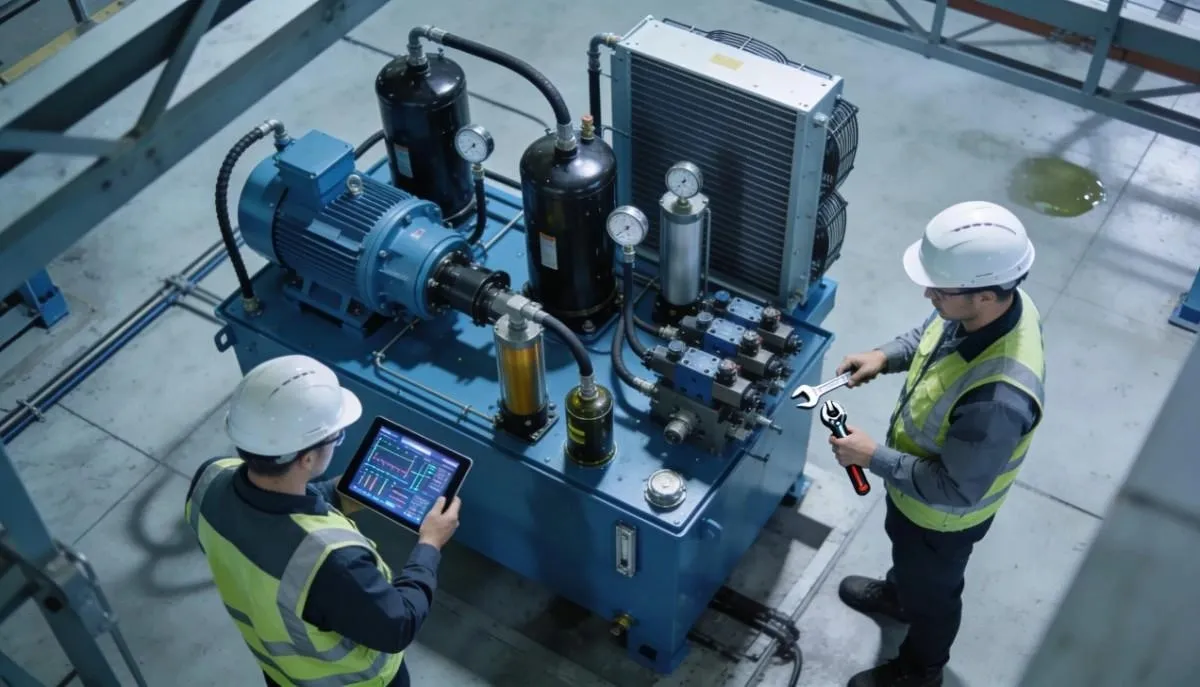
A hydraulic system isn't one thing. It's a full assembly — and any part of it can drag down the rest. Here's what actually matters in a production environment:
- Hydraulic Power Pack — generates pressurised fluid; the engine of the whole system
- Hydraulic Cylinders — convert fluid pressure into linear movement; leaking seals here kill productivity fast
- Directional Control Solenoid Valves — control where fluid goes and when; misfires cause erratic actuator behaviour
- Manifold Blocks — consolidate valves, reduce leak points, keep the system compact and easy to service
- Oil Cooler / Heat Exchanger — stops overheating, which is the silent killer of hydraulic oil and seals
- Hydraulic Hose Pipes — flexible high-pressure connectors that fatigue over cycles; inspect every month
Each of these components, when sourced right, holds a system together for years. When sourced cheap — or worse, ignored during maintenance — you're back to reactive repairs within months.
Key Advantages of Proactive Maintenance
Plants that shift from fix-it-when-it-breaks to watch-it-before-it-breaks see results fast:
- Unplanned stoppages drop — sometimes by half — within the first year of structured maintenance
- Component lifespan extends across pumps, valves, and cylinders when serviced on time
- hydraulic system efficiency stays near design spec instead of quietly drifting down over months
- Emergency calls to a Hydraulic Systems Supplier in India become rare instead of routine
- Maintenance costs become predictable — budgetable — instead of random expensive shocks
Common Causes of Hydraulic Downtime
Some Common Causes of Hydraulic Downtime that are:
- Oil Contamination
- Overheating
- Seal Failure in Cylinders
- Pressure Instability
- Hose Fatigue
Oil Contamination
Dirt is the number one killer of hydraulic components. Particles you can't even see will score pump internals, block spool valves, and chew through seals fast. High-beta return-line filters and regular ISO 4406 oil checks are non-negotiable in any serious plant setup.
Overheating
Hydraulic oil running above 60°C loses viscosity fast. Seals go. Pump efficiency craters. A correctly sized oil cooler stops all of this before it starts. It's one of the most underspent components in Indian plants — and one of the most consequential.
Seal Failure in Cylinders
Internal leakage in Hydraulic cylinders is sneaky. Actuators slow gradually. Pressure drops. By the time it's obvious, you've lost production cycles — and possibly damaged the cylinder bore. Quarterly seal inspections cost next to nothing compared to a full replacement or a lost production day.
Pressure Instability
Maladjusted relief valves and worn modular valves cause erratic pressure. Machines behave unpredictably. Calibrate control valves at every planned shutdown — not after something breaks.
Hose Fatigue
Hydraulic hose pipes running close to rated pressure will crack at fittings over time. Look for bulging, surface cracking, or abrasion marks every month. One failed hose mid-cycle can cascade into far bigger damage across the system.
Industries Where Downtime Hits Hardest
hydraulic equipment runs the backbone of heavy industry. These sectors feel every unplanned stop directly in output:
- Steel and metal forming — presses, rolling mills, heavy hydraulic cylinders
- Automotive manufacturing — transfer lines, stamping presses, assembly jigs
- Construction equipment — excavators, cranes, large material handlers
- Injection moulding — plastic and rubber processing machines
- Paper and packaging — converting, slitting, and winding lines
- Food processing — filling and conveying systems with hygiene-grade actuators
Why the Right Supplier Changes Everything
Here's something most plant managers learn the hard way — the component quality matters, but so does who supplies it. A trusted Hydraulic Systems Dealer in India doesn't just sell parts. They stock proven brands, understand real application conditions, and actually respond when something fails mid-shift.
Working with a reliable Hydraulic Systems Wholesaler in India means faster replacement lead times, access to names like Rexroth, Parker, Yuken, and Eaton, and real application support — not just catalogue numbers. When you're sourcing a hydraulic machine upgrade or a critical spare, that supplier relationship is worth more than a small invoice discount.
|
🔎 FACT: A single hour of unplanned hydraulic downtime in a mid-scale press plant can cost more than an entire year of scheduled preventive maintenance visits combined. |
About NTH
N.T. Associates has spent over a decade building one thing — hydraulic systems that actually hold up. Hydraulic hosepipes, precision components, motors, vane pumps, power packs — everything we make is built around real application demands, not just technical specs.
We don't work through catalogues or assumptions. Every customer conversation starts with understanding the operation — what it handles, where it runs, and what failure costs. That's how we design solutions that fit, not just products that ship.
Manufacturing plants, heavy equipment operators, and process industries across India rely on us because our products are consistent and our support is direct.
Tell us what your system needs. We'll build it.
Conclusion
Hydraulic downtime is a choice — not an inevitability. Plants that treat their industrial hydraulic systems as assets worth monitoring, not just problems to fix after they break, consistently outperform the ones still running on reactive instincts.
Quality hydraulic equipment from a trusted hydraulic systems manufacturer in India, maintained with real discipline and watched for early warning signs — that's the formula. It isn't complicated. It's just rarely done properly. Start with the basics, build the habit, and the results follow.
|
Ready to cut unplanned downtime in your plant? Speak with a Hydraulic equipment expert today. |
Oil contamination. Dirt particles — often invisible — score pump internals and block valves fast. Most plants ignore oil cleanliness until the damage is already done. Regular ISO 4406 checks fix this.
No fixed answer — it depends on duty cycle and contamination levels. Check oil cleanliness every three months. Change when ISO cleanliness drops below acceptable limits, not on a calendar schedule.
Internal seal wear. When seals degrade, fluid bypasses the piston internally — you lose force without any visible leak. Quarterly seal inspection catches this before it costs you a full shift.
Yes — and faster than most people expect. Oil above 60°C loses viscosity, seals harden, and pump clearances tighten. Repeated overheating shortens component life significantly. A properly sized oil cooler prevents it entirely.
Start with the relief valve — it's the most common culprit. Check for wear, wrong setting, or internal dirt. Maladjusted modular valves cause erratic pressure too. Calibrate both at every planned shutdown.
Don't wait for it to burst. Look for surface cracking, bulging near fittings, or abrasion marks monthly. Any of these means the hose is past safe service life — replace it immediately.