
What Are the Three Types of Hydraulic Motors?
- What Is a Hydraulic Motor?
- What Are the Three Main Types of Hydraulic Motors?
- Gear vs Vane vs Piston Hydraulic Motors
- Where Are Hydraulic Motors Used in Industry?
- How to Choose the Right Type of Hydraulic Motor
- Conclusion
You probably walked past a hydraulic motor today without knowing. They sit in a lot of machines you'd never look twice at, and honestly most people only think about them when one fails. So what do they do? Oil goes in under pressure, a shaft spins. That's it. This blog by N.T. Associates covers the three main types of hydraulic motors (gear, vane, piston), where each one gets used, and how to pick one without a headache. Nothing too heavy, promise. Bit of trivia thrown in too, because why not.
Did you know? “A Frenchman called Pascal figured out the rule behind all this in the 1600s. Squeeze a trapped liquid and the pressure spreads through all of it, evenly.”
What Is a Hydraulic Motor?
A Hydraulic motor is kind of a pump in reverse, well, close enough. Pressurised oil flows in and leans on gears, vanes or pistons, depending on the design. Shaft spins. That's the hydraulic motor working principle, no more to it than that. Machines that need real torque from a small body usually end up with an industrial hydraulic motor.
Roughly, the energy travels like this:
- the pump makes flow, driven by an engine or electric motor
- valves decide direction, flow and the pressure limit
- motor shaft turns, and that's the useful work done
- oil returns to the tank and starts over
What Are the Three Main Types of Hydraulic Motors?
Gear, vane, piston. That's the list of hydraulic motor types, though a gear motor won't do a piston motor's job, not really. Which one fits? Depends what your machine asks for. Torque, speed, pressure. Get it wrong and parts wear out early, or power just gets wasted.
Before the detail, here's the quick split, just so you've got the picture:
- gear: simple, rugged, cheap to run, fine for moderate loads
- vane: smooth, steady at medium speed, quiet in use
- piston: high pressure, high torque, made for heavy work
1. Gear Hydraulic Motors
A gear hydraulic motor, or hydraulic gear motor, is built around two gears meshing. Oil gets forced between the teeth and the wall of the housing, so the gears turn and the shaft turns with them. There's very little inside. Less to go wrong, which is why it's so common as an industrial hydraulic motor on everyday jobs.
Worth knowing about gear motors:
- few parts, so servicing is quick
- copes with dusty, rough workshop conditions
- moderate torque only; fine for light to medium loads
- seen on conveyors, farm machines and material-handling lines
- usually costs less than piston types
- pressure rating is lower than piston motors, so check the datasheet
Did you know? Some gear pumps can run as motors too, if oil under pressure is fed in. Pump and motor are cousins, really.
2. Vane Hydraulic Motors
Picture a rotor with thin blades that slide in and out of slots, all inside a ring. That's a vane hydraulic motor, or hydraulic vane motor. Oil shoves the blades, the rotor goes round, and you get very little pulsing. People buy it for the smooth feel, so have a look if your machine hates jerks.
Where vane motors do well:
- rotation stays smooth, torque ripple is low
- medium speeds are where they sit best
- efficiency holds up in normal working conditions
- good fit for equipment needing consistent motion, one of the usual hydraulic motor applications
- a little more complex than gear motors, a lot simpler than piston ones
3. Piston Hydraulic Motors
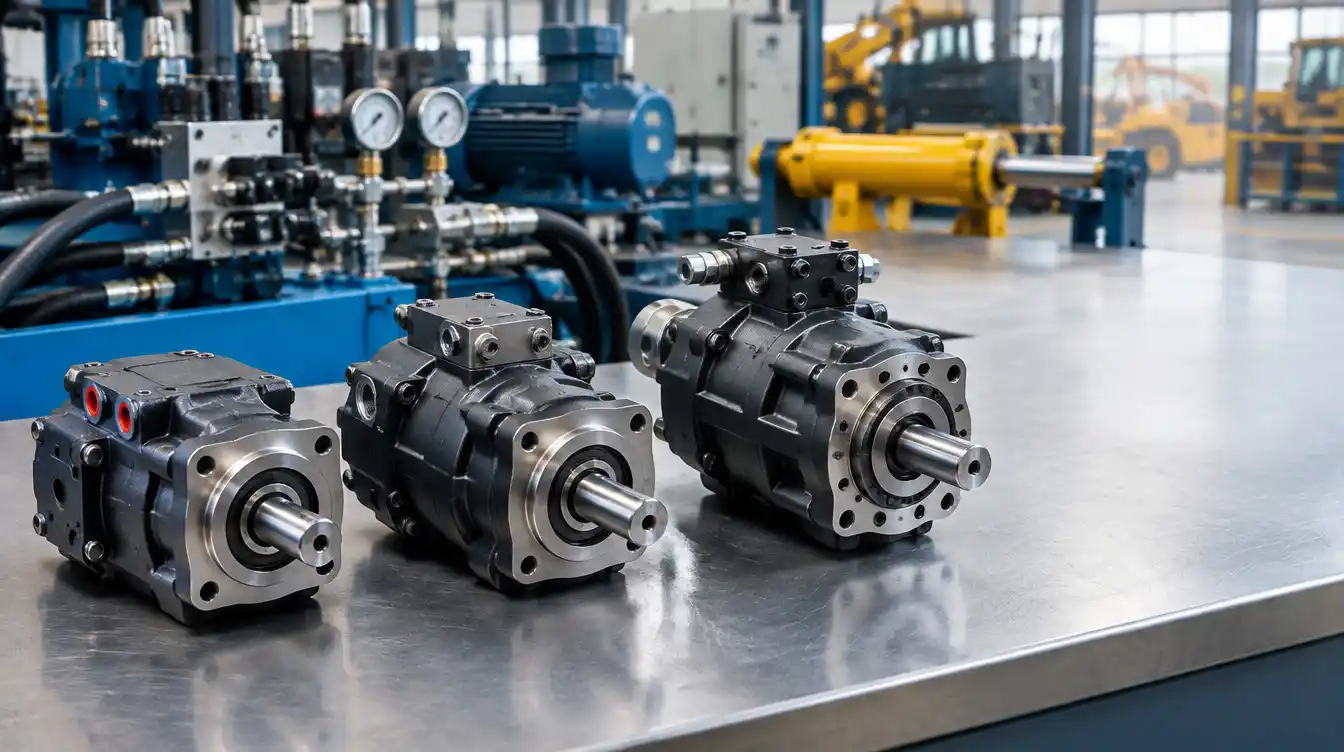
Now the heavy one. A piston hydraulic motor has pistons going in and out of a cylinder block as oil pressure acts on them. Axial types keep the pistons parallel to the shaft; a radial piston hydraulic motor puts them around it. That layout is what gives you a proper high torque hydraulic motor. Efficiency is decent too.
The main points on piston motors:
- axial ones are compact and efficient, fine with higher speeds and pressures
- radial ones give big torque at low speed, so heavy loads aren't an issue
- built for high pressure and hard duty cycles
- winches, presses and similar heavy machinery suit them
- the downside: higher cost, more complexity, so size them carefully
|
Continue Reading: Explore Our Related Article |
Gear vs Vane vs Piston Hydraulic Motors
Put side by side, the gaps show up fast. This Hydraulic motor comparison looks at pressure, speed, torque, efficiency, durability and complexity. Figures change from model to model, so take the points below as general tendencies and nothing more.
For gear vs vane vs piston motor, the usual picture is:
- gear – moderate pressure and torque, simple and durable, least complex; typical for general duties like conveyors
- vane – medium pressure and speed, smooth, reasonably efficient, moderately complex
- piston – highest pressure and torque, high efficiency, most complex; built for heavy industrial use
So the harder the job gets, the easier a piston motor is to justify on cost.
Where Are Hydraulic Motors Used in Industry?
Walk round a factory, a farm or a building site and hydraulic motors are there, doing the dull heavy work. Hydraulic motor applications cover loads of ground. Where loads get punishing, somebody specifies a heavy duty hydraulic motor. N.T. Associates can talk through a hydraulic motor for industrial machinery in any of these settings.
Places you'll commonly see them:
- Conveyors, moving bulk and packaged goods
- Construction equipment, for drive and swing functions
- Presses, where rotary power needs to be controlled
- Winches that lift and pull
- Agricultural machinery like augers and spreaders
- Material-handling systems and factory automation
Did you know? “Here's one for the break room: certain radial piston motors turn so slowly and push so hard that the machine doesn't need a gearbox.”
How to Choose the Right Type of Hydraulic Motor
Don't open the catalogue yet. First figure out what your machine is being asked to do, and only then line that up with a motor's rated limits. Good hydraulic motor selection saves headaches later. Wondering how to choose hydraulic motor options for your industrial hydraulic motor needs? N.T. Associates is happy to think it through with you.
Run through this list first:
- Torque needed to start and run the load
- The speed range the machine works in
- Pressure and flow, which have to match your pump and circuit
- Duty cycle: nonstop, on and off, or shock-loaded
- Load conditions on the shaft, radial and axial
- The environment, from heat to dust to moisture
- How easy servicing and spares will be
Conclusion
Quick recap. Gear motors are the simple, cheap option. Vane motors run smooth at medium speed. Piston motors take over once pressure and torque get high. What you pick really depends on torque, speed, pressure and the job. Browsing for an industrial hydraulic motor? Look through the Hydraulic Motor range from N.T. Associates. Stuck? Work out the load first, then speed, then pressure. By that point you'll have two or three motors left to compare.
| Need a dependable hydraulic motor supplier in India? Talk to N.T. Associatesand discuss your motor type, torque, pressure and delivery requirements. |
Piston motors, mainly the radial kind. Several pistons push on a cam ring, which makes a lot of turning force even when the shaft barely moves. That's why they end up on winches, heavy presses, mixers and other jobs where torque is the whole point.
No single type wins here. It comes down to design, flow, pressure and load. Gear motors and some axial piston motors cope with higher speeds okay, whereas radial piston motors like it slow and heavy. Check the maker's speed limits first, before you finalise anything.
Pumps get driven by an engine or an electric motor, and all they do is shove oil around the circuit. Mechanical power in, hydraulic power out. A motor is really just the reverse. Pressurised oil comes in, shaft rotation comes out, and that rotation is what actually moves the machine.
Conveyors mostly. Also farm machinery and material-handling kit, and any other spot where plain, steady rotation is all that's needed. They're compact, moderate on torque, and there's little to maintain. Nobody gets excited about them, but they keep turning, shift after shift, and plants like that.
Some can, yes. Radial piston ones are the usual pick for slow, heavy work, and plenty of them drive the load directly with no gearbox in between. How slow? Depends on the model. Honestly the spec sheet will tell you more than any general rule, so read that first.
Torque and speed, obviously. Displacement too, plus pressure, flow, load and duty cycle. Mounting and shaft arrangement come next, plus the spot where it'll actually run. Heat and dirt wear a motor down quicker than most buyers think. Stay within the rated limits and the motor ought to last.